How to Choose an Angle Grinder: A Buyer's Guide for 2026
Recommended picks


Disc Size and the Grinder Class It Defines
Angle grinders are grouped by the maximum wheel diameter they accept, and that diameter determines everything from wheel speed to usable power. The 4.5-inch format is the mainstream workhorse: corded models in this class, such as the DEWALT DWE402 (120V corded, 1320 watts, 11000 RPM, 6 lbs, $94) and the Makita 9557PBX1 (120V corded, 900 watts, 11000 RPM, $109), handle cutting bar stock, grinding welds flush, and stripping rust or paint from flat surfaces. At the large end of the range, the Makita GA7021 (120V corded, 1800 watts, 6000 RPM, 15.4 lbs, $209) is built for heavy stock removal on structural steel or concrete, where the larger wheel covers more surface per pass and the lower no-load RPM keeps the larger wheel within safe operating limits. Choosing a bigger disc does not automatically mean more cutting power; it means more wheel surface area and a lower RPM ceiling, so the decision should come from the material thickness and job volume you are actually facing.
Power Source: Corded, Cordless, or Air-Powered
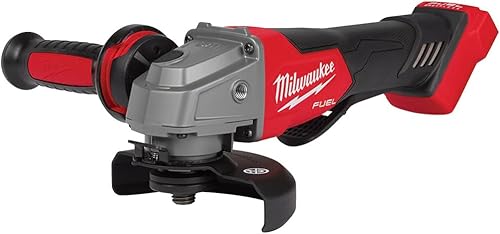
Corded grinders deliver continuous, uninterrupted power and are the natural default for sustained bench or fabrication work. The DEWALT DWE402 at $94 and the Makita 9557PBX1 at $109 are both 120V tools that run as long as the outlet holds, with no battery to manage. Cordless models trade some sustained output for portability and convenience. The Milwaukee 2880-20 (18V battery powered, 800 watts, 8500 RPM, $149.99) and the DEWALT DCG413B (20V battery powered, 3450 RPM, $149.61) eliminate cord drag that matters on scaffolding, in vehicle frames, or in locations far from power. Owners report that modern 18V and 20V cordless grinders are capable enough for most cutting and grinding tasks when used with fully charged batteries. Air-powered grinders like the AIRCAT 6280 (air powered, 18000 RPM, 1.8 lbs, $105.63) require a compressor but reward users with a very light, cool-running tool that suits sustained precision work in a shop environment. The trade-off is the compressor investment and the air hose tether.
Motor Wattage and How It Handles Load
Wattage is the most direct measure of how well a corded angle grinder resists bogging down under load. The Makita 9557PBX1 at 900 watts is adequate for light fabrication, cutting thin sheet metal, and light surface grinding. The DEWALT DWE402 steps up to 1320 watts, which provides noticeably more headroom when pushing through thicker plate, angle iron, or hard materials without stalling. The Makita GA7021 at 1800 watts is at the top of the corded angle grinder range and is the right choice for continuous heavy grinding sessions on structural steel or masonry where a lower-wattage tool would bog or overheat. For cordless models, the Milwaukee 2880-20 lists 800 watts at the motor, and owners report it handles most metal-cutting tasks without issue. Keep in mind that battery state of charge affects actual delivered power in cordless tools, so starting a demanding cut on a depleted pack will reduce effective performance regardless of the motor rating.
Understanding Speed (RPM) and Wheel Compatibility
No-load RPM is the speed at which the spindle spins when the grinder runs free of a workpiece, and it is the number you must match to your wheel rating. Standard 4.5-inch angle grinders like the DEWALT DWE402 and Makita 9557PBX1 run at 11000 RPM. The Milwaukee 2880-20 operates at 8500 RPM, which is common for cordless 4.5-inch to 5-inch tools balancing power draw and battery runtime. The Makita GA7021 runs at 6000 RPM to keep its large wheel within a safe surface speed. The AIRCAT 6280 at 18000 RPM is calibrated for die-grinder-style work with small-diameter mounted points, not standard angle grinder wheels. Before mounting any wheel or disc, confirm that the wheel's stated maximum RPM equals or exceeds the tool's no-load RPM; mounting an under-rated wheel is the primary cause of catastrophic disc failures on grinders. This rule applies regardless of whether the grinder is corded, cordless, or pneumatic.
Weight, Dimensions, and Fatigue on the Job
Weight accumulates fast on grinding tasks that run for more than a few minutes. The DEWALT DCG413B lists a tool weight of 1 lb (body only, without battery) and measures 12.2 inches long, which makes it one of the most maneuverable options in the category. The AIRCAT 6280 at 1.8 lbs and 7 inches long is similarly light for pneumatic precision work. The DEWALT DWE402 at 6 lbs is a substantial step up and is the weight class most associated with full-size corded 4.5-inch grinders. The Milwaukee 2880-20 comes in at 79.82 ounces (roughly 5 lbs) with a body that measures 13 inches long by 8.5 inches wide, suited to two-hand grinding. The Makita GA7021 at 15.4 lbs and 21.25 inches long is a two-hand-only tool that should never be used overhead for extended periods. For overhead cuts, weld grinding in tight spaces, or any application requiring frequent repositioning, prioritize lighter models. For bench or floor grinding where the tool rests against a surface, heavier tools can actually steady the cut.
Battery Platform Compatibility
Choosing a cordless angle grinder from a battery platform you already use avoids buying additional chargers and packs. DEWALT 20V MAX users have two grinder options in the sample data: the DEWALT DCG413B at $149.61 and the DEWALT DCG412P2 at $229.98 (20V, 8000 RPM). Milwaukee M18 owners will find the Milwaukee 2880-20 at $149.99 (18V, 8500 RPM, 800 watts) integrates directly with their existing packs. Makita 18V users can consider the Makita XAG09Z at $187 (18V battery powered, 10000 RPM). The die-grinder-class DEWALT DCK203P1 kit at $319 also runs on 20V and operates at 25000 RPM for precision mounted-point work. If you have no existing battery ecosystem, the DEWALT DWE402 at $94 corded is the most cost-effective entry point confirmed by buyer demand: it draws 1000 or more purchases per month based on verified sales data.
Common mistakes to avoid
- Mounting a grinding wheel rated for lower RPM than the tool's no-load speed; a wheel rated below the grinder's operating speed can shatter mid-cut.
- Choosing a large-format model like the Makita GA7021 for general shop use without accounting for its 15.4-pound weight and requirement for constant two-hand control.
- Assuming all corded grinders deliver equal cutting ability and overlooking the difference between a 900-watt and a 1320-watt motor under sustained load.
- Running a cordless grinder on a heavily depleted battery and blaming the tool for sluggish performance, rather than recharging or swapping the pack before the task.
- Skipping the side handle on compact models and relying only on the rear grip, which reduces control and significantly increases the risk of kickback.
- Treating the AIRCAT 6280's 18000 RPM as a sign of greater grinding power, when that speed class is intended for small-diameter die grinder work and is not appropriate for standard angle grinder wheels.
Frequently asked questions
What disc size do most angle grinders use?
4.5-inch is the dominant size for both DIY and trade work. The DEWALT DWE402 and Makita 9557PBX1 are both designed for this format and run at 11000 RPM. The Makita GA7021 accepts larger wheels and runs at 6000 RPM for heavy industrial grinding.
Is a cordless angle grinder powerful enough to cut metal?
Based on specs and verified owner reviews, modern 18V and 20V cordless grinders handle most metal-cutting tasks adequately. The Milwaukee 2880-20 at 18V and 800 watts carries a 4.8-star rating across 2,400 reviews, and around 1,000 owners buy it per month, which is a strong demand signal for real-world trade use.
What is the right RPM for a 4.5-inch angle grinder?
Most corded 4.5-inch models run at 11000 RPM, as shown by the DEWALT DWE402 and Makita 9557PBX1. Cordless 4.5-inch grinders like the Milwaukee 2880-20 typically run at 8500 RPM. Always confirm the wheel you mount is rated for at least the tool's no-load RPM before use.
How much does a reliable angle grinder cost?
Corded options start around $94 for the DEWALT DWE402 (1320 watts, 4.8 stars, 5,400 reviews) and $109 for the Makita 9557PBX1 (900 watts). Cordless models from DEWALT and Milwaukee with 18V or 20V platforms run $149 to $230. A large-format corded model like the Makita GA7021 (1800 watts) is priced at $209.
Can I use the same grinder for cutting and grinding?
Yes, but you need to swap the disc type: cutting wheels are thin and optimized for slicing through metal or masonry, while grinding wheels are thicker and shaped for stock removal and surface work. Both mount on the same tool, provided each disc is rated for the tool's maximum RPM. Never use a cutting disc for lateral grinding pressure, as it can fracture.
What should I consider if I already own a DEWALT battery platform?
The DEWALT DCG413B ($149.61, 20V) and DEWALT DCG412P2 ($229.98, 20V, 8000 RPM) both use the 20V MAX battery system. If you primarily do light grinding and value maneuverability, the DCG413B is the natural fit. For heavier cutting where more speed matters, the DCG412P2 at 8000 RPM provides a higher no-load speed. Either tool shares batteries and chargers with DEWALT 20V drills, saws, and other tools.