Corded vs Cordless Drills: Which Should You Buy?
Recommended picks


How Power Delivery Actually Differs
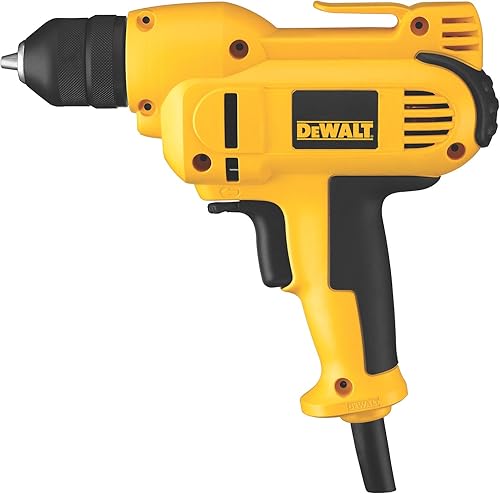
The most important difference between corded and cordless drills is not raw speed but sustained power delivery. A corded drill like the DEWALT DWD115K draws 8 amps directly from a 120-volt outlet, giving it a consistent 2500 RPM throughout every bit change and every hour of use. Nothing degrades that output mid-task. A cordless drill, by contrast, pulls from a battery whose voltage sags slightly as the charge drops. The DEWALT DCD777D1, running at 20 volts with a 2-amp battery, tops out at 1500 RPM and gradually loses urgency as the pack drains toward 20 percent remaining charge. For most drill-and-drive work, that degradation is imperceptible. For long runs of large-diameter holes in hardwood or masonry, the corded drill's unvarying draw is a genuine advantage. Buyers who drill continuously for hours on production sites often keep one corded drill alongside a cordless kit for exactly this reason. The DEWALT DWD115K is priced at $98.65 and carries 1,857 reviews at 4.8 stars, suggesting it satisfies a broad range of demanding users across Drill Drivers and Hammer Drills alike.
The Case for Cordless: Freedom and Modern Voltage
The shift from corded to cordless over the past decade tracks one development: 20-volt lithium-ion platforms became capable enough to replace corded tools for almost all non-continuous tasks. The DEWALT DCD777D1 at $99.00 is currently bought by roughly 4,000 shoppers per month, making it the highest-demand drill in this section by a wide margin. Its 1500 RPM, 20-volt, 5.1-pound body handles cabinet installation, deck screwing, furniture assembly, and outlet-box drilling without any cord to manage. Milwaukee's 12-volt platform illustrates another cordless strength: the Milwaukee 2407-20, rated at 1500 RPM with a body weight of 16 ounces, is so light that fatigue is essentially eliminated for overhead or confined-space work. The Bosch GSR12V-300FCB22 (12 volts, 1750 RPM, $139.00, with 1,000 purchases per month) reinforces the same trend: compact cordless platforms now handle a remarkably broad workload, and the absence of a cord is meaningful wherever outlets are scarce, such as rooftops, crawl spaces, or framing work inside unfinished shells. For buyers already on a 20-volt platform with multiple tools sharing one battery family, adding a cordless drill fits seamlessly into an existing setup.
Voltage and Amps: What the Numbers Mean
Voltage determines the torque ceiling, and amperage (expressed in amp-hours on battery tools) governs how long a charge lasts. On corded drills, amperage is a continuous draw figure: the DEWALT DWD115K's 8 amps reflects real motor demand at load, enabling its 2500 RPM output with no thermal throttle under normal use. On cordless tools, the voltage listed (12 volts, 18 volts, 20 volts) is the nominal battery voltage. A 20-volt, 2-amp-hour pack in the DEWALT DCD777D1 will power the tool through a typical workday of varied drilling and driving tasks. If you need more runtime rather than more power, a 4-amp-hour pack is a practical upgrade. The DEWALT DCH133B (20 volts, 4 amps, $229.00, 2,000 reviews at 4.8 stars) demonstrates how a higher-amperage battery extends run time while keeping the same 1500 RPM nominal speed. Weight climbs with battery size, and that tradeoff is real: the DCD777D1 is listed at 5.1 pounds with battery, versus the 1.9-pound DEWALT DCD701F2 on a 12-volt, 2-amp platform at $124.13. Lighter battery packs mean less fatigue but more frequent charging on a busy day. The right amp-hour choice depends on how many hours of continuous use you actually need between stops.
Weight and Fatigue on the Job
Weight is where cordless drills vary more than many buyers expect. The Milwaukee 2407-20, at 16 ounces as a bare body, is exceptionally light for overhead work or extended periods in tight spaces. The DEWALT DCD701F2 lists 1.9 pounds with a 12-volt battery installed, making it one of the lightest complete cordless packages at $124.13. The Milwaukee 2505-22, also 12 volts, checks in at 2 pounds and 1600 RPM at $172.00, offering a balance of platform speed and low fatigue load. At the other end, the Milwaukee 2997-22 tips the scale at 14.9 pounds, a two-tool professional kit at $429.00. That mass reflects a large battery and a high-capacity platform, not a design flaw. It is intended for heavy-duty production drilling where sustained torque matters more than ergonomics over a full shift. Corded drill bodies themselves tend to be lighter than a cordless body-plus-battery combination, but the cord introduces physical resistance and trip hazards that offset any weight benefit. When choosing between cordless options, always compare complete-tool weight including the battery you plan to use, not just the bare-body spec listed on product pages.
Cost: Entry Price vs Long-Term Platform Investment
On first glance, corded and cordless drills sit at similar entry prices. The DEWALT DWD115K (corded) costs $98.65, and the DEWALT DCD777D1 (cordless kit, battery and charger included) costs $99.00. The real cost difference emerges over time. Once you own a 20-volt DEWALT battery, every bare-tool purchase in that platform skips the cost of an extra battery and charger, saving $50 to $80 per tool. Cordless owners who already hold two or three tools on the same platform are effectively paying less per added tool than the kit prices suggest. Corded drills carry no battery replacement cost and no charger cost, making them the simplest long-term budget if you own only one or two power tools. For a buyer doing infrequent weekend work, the DEWALT DWD115K at $98.65 provides maximum output per dollar with zero concern about battery age. For buyers who already own or plan to own multiple cordless tools, building on one platform becomes the better long-term investment even if the first kit costs slightly more. The WORKPRO W009152 at $99.74 (20 volts, 1300 RPM, 600 bought per month, 1,432 reviews) is a budget cordless option for buyers who do not need brand-ecosystem compatibility and want to keep initial spend low.
Matching the Right Drill Type to Your Tasks
The Drills section spans Drill Drivers, Hammer Drills, Rotary Hammers, Right-Angle Drills, Core Drills, Screw Guns, Power Screwdrivers, Benchtop Drill Presses, Stationary Drill Presses, Magnetic Drill Presses, and Mortisers. Cordless drill drivers dominate light to medium work across nearly every handheld category. Corded electric shines in stationary setups such as Benchtop and Stationary Drill Presses, where mobility is irrelevant and sustained motor power is an asset. For hammer drilling into concrete or masonry, corded models historically held the power advantage, but modern 20-volt hammer drills now provide competitive impact energy for most residential anchoring tasks. The DEWALT DCH133B (20 volts, 4 amps, 5 pounds, $229.00) is a cordless hammer drill with 2,000 reviews at 4.8 stars suited for installing structural anchors, setting masonry screws, and occasional light concrete drilling. Heavy rotary hammer work into thick reinforced concrete still favors corded electric for uninterrupted runtime over long sessions, but for most homeowner and light commercial anchor work, a quality cordless hammer drill covers the need. Right-Angle Drills and compact Screw Guns are almost exclusively cordless in practice, where the goal is access and speed, not peak torque.
Making the Final Call
For most buyers in 2026, a 20-volt cordless drill is the right answer. The DEWALT DCD777D1's combination of 4,000 monthly purchases, 4.8 stars across 2,200 reviews, and a $99.00 kit price reflects genuine market consensus: this class of tool satisfies the overwhelming majority of drill-and-drive needs without a cord. Choose corded when your work requires multi-hour continuous drilling at high RPM without pausing to swap batteries. The DEWALT DWD115K at 2500 RPM and 8 amps is built for exactly that use pattern. Choose a 12-volt cordless platform if weight is the primary concern and your tasks are light: the Milwaukee 2407-20 at 16 ounces or the Bosch GSR12V-300FCB22 at 12 volts and 1750 RPM are strong picks in that tier. Choose a 20-volt cordless platform if you want one battery family to span drills, impact drivers, circular saws, and other tools over time. Avoid buying a bare-tool cordless drill if you have no battery from that brand and voltage already in hand, unless the bare-tool price clearly accounts for that missing cost.
Common mistakes to avoid
- Buying a cordless bare tool without checking whether you already own a compatible battery from the same brand and voltage platform, which can make the bare tool more expensive than a kit from a different brand.
- Assuming higher voltage always means faster RPM: the DEWALT DCD777D1 (20 volts) and DCD701F2 (12 volts) both list 1500 RPM maximum, because gear ratio and chuck design affect output speed alongside voltage.
- Comparing bare-body weight figures without accounting for the battery: a 16-ounce Milwaukee 2407-20 body gains significant mass once a full-size 20-volt pack is installed.
- Choosing a corded drill to avoid battery hassle without accounting for the fact that outlet access on many jobsites requires long extension cords that introduce both a trip hazard and a voltage drop.
- Using a standard cordless drill driver to attempt hammer drilling into concrete: without a dedicated hammer mode, a drill driver will not penetrate masonry effectively regardless of voltage or RPM.
- Ignoring battery platform longevity: lithium-ion cells lose capacity over hundreds of charge cycles, so a cordless drill bought two years ago may perform noticeably weaker today even if the specs on the box have not changed.
Frequently asked questions
Is a cordless drill powerful enough to replace a corded drill for most home use?
Yes. Modern 20-volt cordless drills such as the DEWALT DCD777D1 (1500 RPM, 5.1 pounds, $99.00, 4.8 stars across 2,200 reviews) handle the vast majority of household drilling and driving tasks without issue. Corded drills offer a genuine advantage only for sustained heavy drilling where battery runtime would become a practical constraint during a long work session.
What amperage should I look for in a corded drill?
Based on verified listings in this section, the DEWALT DWD115K at 8 amps and 2500 RPM represents a strong all-around corded option for $98.65. For light work, 5 to 6 amps is sufficient. For sustained large-diameter drilling in hardwood or through metal, 7 to 10 amps is the practical range to target.
Does voltage matter as much as RPM when comparing cordless drills?
RPM is the more immediately useful spec for most buyers because it reflects actual output speed at the chuck. Both the 20-volt DEWALT DCD777D1 and the 12-volt DEWALT DCD701F2 list 1500 RPM maximum. Voltage affects torque potential and battery runtime more than it directly determines no-load speed, so do not use voltage alone as a proxy for power.
Can I use a cordless drill for hammer drilling into concrete?
Only if the model has a dedicated hammer mode. A standard cordless drill driver cannot substitute for a hammer drill or rotary hammer. The DEWALT DCH133B (20 volts, 4 amps, $229.00, 2,000 reviews at 4.8 stars) is a cordless hammer drill designed for exactly this use case, covering masonry anchors and light concrete drilling from battery power.
Is a 12-volt cordless drill worth buying over a 20-volt?
Yes, for light tasks where weight and balance are priorities. The Bosch GSR12V-300FCB22 (12 volts, 1750 RPM, $139.00, 1,000 bought per month) and the Milwaukee 2505-22 (12 volts, 2 pounds, 1600 RPM, $172.00) are compelling at this voltage for overhead work, tight spaces, and everyday light assembly. The tradeoff is less torque headroom compared to 20-volt platforms when tackling denser materials.
When does it make sense to own both a corded and a cordless drill?
Owners who drill continuously for multiple hours on production or renovation sites often keep both. The corded model handles sustained heavy runs where battery swaps would interrupt workflow. The cordless handles portability, driving, and work away from outlets. Based on the specs and review data in this section, the DEWALT DWD115K (corded, 8 amps, 2500 RPM) paired with the DEWALT DCD777D1 (cordless, 20 volts, 1500 RPM) is a practical two-drill setup that covers both scenarios at a combined cost near $200.