How to Choose a Nail Gun: A Practical Buyer's Guide
Recommended picks


Nail Gun Types: Match the Tool to the Task
The Nailers and Staplers category covers a wide spectrum of fastening tools, and buying the wrong type is the most common and costly mistake. Brad nailers and pin nailers drive the thinnest fasteners (18-gauge brad nails or 23-gauge pins) and are the right choice for attaching thin trim, moldings, and small decorative pieces where you need minimal surface damage and a nearly invisible hole. Finish nailers step up to 15- or 16-gauge fasteners for heavier trim, baseboards, door casings, and cabinet face frames that need a stronger hold. Framing nailers handle structural work, driving 2-inch to 3.5-inch full-head or clipped-head nails into dimensional lumber for walls, floors, and roof sheathing. Roofing nailers are optimized for speed and drive angle, shooting coil-collated nails flat into shingles without lifting the tool between fasteners. Flooring nailers and cleated staplers are purpose-built for tongue-and-groove hardwood installation, holding the tongue angle precisely to avoid surface damage. Siding nailers and construction staplers cover exterior cladding and sheathing applications where fastener holding strength per square foot matters. If you pick a brad nailer for framing work, it will not have the drive power to hold structural loads. If you grab a framing nailer for crown molding, you will split the wood at every nail point. Start by identifying the exact gauge and length of fastener your job requires, then find the tool built for that spec.
Power Source: Pneumatic vs. Cordless
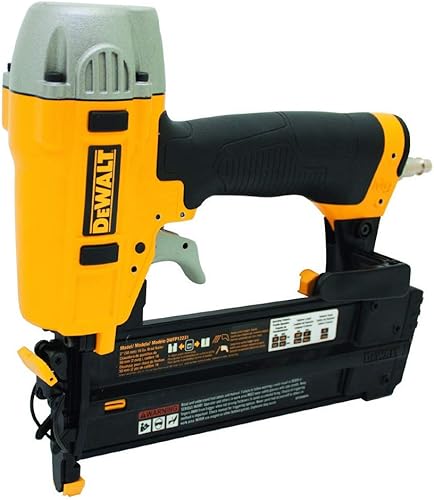
Nail guns run on one of two practical power sources: compressed air (pneumatic) or a rechargeable battery (cordless). Pneumatic nailers require an air compressor and hose, but they tend to be lighter and more affordable upfront. The DEWALT DWFP12231 is a well-reviewed pneumatic option at $107.99 with a listed weight of 2.65 pounds and body dimensions of 13 x 3.7 x 12 inches, which reflects how compact a well-designed pneumatic tool can be. Based on 5,003 verified owner reviews at a 4.7-star rating, owners consistently mention the light weight as a genuine advantage for sustained overhead trim work. Cordless nailers offer freedom from hoses but carry the battery weight. The Metabo NT1850DG runs on an 18-volt battery system, weighs 5.5 pounds, and measures 11 x 3.5 x 10 inches. Priced at $129, it has 837 reviews at 4.8 stars and is one of the current top sellers in the category with 1,000 units bought last month, which reflects strong demand from buyers who prioritize job-site mobility. For a fixed workshop or a job site with a compressor already on hand, pneumatic tools offer better value per dollar spent. For remodeling work across multiple rooms or outdoor decking projects where running a 50-foot hose is a genuine nuisance, the cordless option justifies the weight premium and higher purchase price.
Fastener Gauge and Length: Getting the Numbers Right
Nail guns are not universal. Each model accepts a specific gauge and collation type, and mismatching these will jam the tool or fail to seat fasteners correctly. Gauge is a wire-diameter measurement: lower numbers mean thicker, stronger nails. A 15-gauge finish nailer drives heavier fasteners suited to door casings and thick baseboards where pulling resistance matters. An 18-gauge brad nailer is the right call for lightweight trim and small pieces of millwork where you want minimal surface damage. Pin nailers at 23-gauge leave virtually no visible hole, making them ideal for veneers and fine furniture assembly, but too weak for any load-bearing trim application. Fastener length is equally important. For 3/4-inch stock you need a nail long enough to reach solid backing through the material, typically at least 1.5 inches. For 3/4-inch hardwood flooring over a plywood subfloor, flooring nailers typically drive 1.5-inch to 2-inch cleats into the tongue. Check the accepted nail length range in the product spec before you commit. A mismatch costs you either a return shipment or a job-site delay. Nail collation angle also varies by manufacturer and by region. Confirm the collation angle (usually 21-degree, 28-degree, or 30-degree for framing nails) matches the fasteners you can source locally before adding any nailer to your cart.
Weight and Dimensions: Fatigue on Long Jobs
Tool weight is an underrated spec on the buying page but a real factor after two hours on the job. Pneumatic nailers tend to be lighter than cordless models because the battery pack adds significant mass. The DEWALT DWFP12231 comes in at 2.65 pounds (air-powered, no battery), while the Metabo NT1850DG cordless is 5.5 pounds with its 18-volt battery. For a professional running a nailer overhead on crown molding for a full day, that nearly 3-pound difference is noticeable by mid-afternoon. At the lighter end of the spectrum, the Metabo NP35A is listed at 2 pounds and priced at $67.15, making it one of the most carry-friendly options in the section. At the heavier end, the Freeman PFS9 weighs 8 pounds, placing it in the heavy-duty tier where greater mass typically comes paired with higher drive force for dense or thick lumber. The Metabo NR90AES1, an air-powered nailer at $169, weighs 7.5 pounds with body dimensions of 15 x 9 x 9 inches and 2,445 reviews at 4.7 stars with 800 units bought last month, making it a consistently popular choice among buyers who need a full-size framing nailer. When planning an all-day nailing project, factor in total carry weight over the full shift, not just the spec-sheet number.
Budget Ranges: What to Expect at Each Price Point
Nail guns in the current verified listings span from under $70 to nearly $400. At the entry level, the Metabo NP35A comes in at $67.15 for a 2-pound pneumatic pin nailer rated 4.7 stars by 1,800 owners. The pneumatic mid-range, roughly $99 to $130, offers the strongest combination of review volume and real-world reliability. The BOSTITCH BTFP12233 at $98.95 holds a 4.8-star rating across 2,616 reviews, and the DEWALT DWFP12231 at $107.99 has earned 5,003 reviews at 4.7 stars with 300 units bought last month. The Metabo HPT Finish Nailer (B07MDDT2LV), a pneumatic model priced at $119, has 1,800 reviews at 4.7 stars and 600 units bought last month, reflecting steady trade demand for a capable mid-range finish nailer. Moving up, the Metabo NT1850DG at $129 delivers 18-volt cordless convenience. The premium tier, represented by the DEWALT DCN680D1 at $399 with 3,400 reviews at 4.8 stars, targets professionals who need a platform-matched cordless nailer that integrates with their existing DEWALT battery system. For occasional DIY use, the mid-range pneumatic tools offer the best return on investment. For daily professional use where compressor access is not always guaranteed, the premium cordless options justify the higher upfront cost through job-site flexibility.
Magazine Style and Nail Collation: Feed Reliability Matters
How nails are held in the magazine directly affects reload frequency and the range of fasteners you can source. Stick or strip magazines hold nails in angled or straight strips and are standard on brad, finish, and most framing nailers. Coil magazines hold a significantly larger nail count and are common on roofing nailers and high-production framing nailers, where a job might require driving several hundred nails without reloading. Within framing nailers, full-head versus clipped-head nails is a building-code issue in some jurisdictions. Certain wind-load and seismic codes require full-head fasteners in structural sheathing. Confirm local code requirements before buying a clipped-head framing nailer if your project involves permitted structural work. Nail collation angle also varies. Most framing nailers accept either 21-degree plastic-strip, 28-degree wire-weld, or 30-degree paper-strip collation, and these are not interchangeable across tools. Buying the wrong collation prevents you from using locally available fasteners and can leave you in a poor position mid-project when the correct strip is not in stock.
Pre-Purchase Checklist: Six Questions Before You Add to Cart
Working through a brief checklist before purchasing prevents the most common return scenarios. First, identify the exact job: trim, framing, roofing, flooring, siding, or upholstery. Each maps directly to a specific nailer type from this section. Second, check your compressor: does it supply enough CFM and PSI to run a pneumatic nailer at production speed? Underpowered compressors cause weak drives and jams. Third, check your battery platform: if you already own an 18-volt tool kit, a cordless nailer on that same platform avoids buying an extra charger and keeps your battery inventory simple. The Metabo NT1850DG operates on an 18-volt battery and ships with the battery included (battery: Yes in the listed specs), which reduces extra kit cost. Fourth, confirm the gauge and nail-length range accepted by the tool matches the fasteners your job actually requires. Fifth, weigh the total tool weight against the duration and position of your work. A 7.5-pound pneumatic framing nailer like the Metabo NR90AES1 is reasonable for ground-level framing but fatiguing for overhead soffit work. Sixth, use review count and recent sales velocity as a reliability signal. Tools like the DEWALT DWFP12231 with 5,003 reviews and the DEWALT DCN680D1 with 3,400 reviews give you a wide pool of real-world owner feedback that spec sheets alone cannot provide.
Common mistakes to avoid
- Buying a brad nailer for a job that requires a finish or framing nailer, resulting in fasteners that pull out under normal load.
- Ignoring nail collation type and angle, then finding the tool does not accept locally available fastener strips.
- Choosing a cordless nailer on an unfamiliar battery platform without confirming whether the battery is included or sold separately.
- Overlooking total tool weight when planning extended overhead nailing, where a 3-pound difference between pneumatic and cordless becomes significant fatigue by end of day.
- Using a framing nailer on delicate finish trim, which splits thin wood and requires filler on every nail hole.
- Not confirming the accepted nail length range, leading to misfires with shorter pins or through-drives on longer fasteners that exit the back of the workpiece.
Frequently asked questions
What is the difference between a brad nailer and a finish nailer?
Brad nailers drive 18-gauge nails that leave a very small hole, suited for light trim and thin moldings. Finish nailers use 15- or 16-gauge nails that hold heavier trim pieces, baseboards, and door casings more securely. The finish nailer leaves a slightly larger hole that needs filling, but provides significantly more holding strength for substantial millwork.
Do I need an air compressor to use a nail gun?
Only for pneumatic models. Air-powered nailers like the DEWALT DWFP12231 require a compressor and hose to operate. Battery-powered cordless models like the Metabo NT1850DG run on an 18-volt battery with no compressor needed, though they weigh more (5.5 pounds vs. 2.65 pounds for the DWFP12231) and cost more upfront.
How do I know which nail gauge my gun accepts?
The gauge and collation type are listed in the product spec sheet and packaging. Nailers are not interchangeable across gauges. Using the wrong fastener size causes jams and can damage the tool or magazine. Always verify gauge, collation type, and accepted nail-length range before purchasing the tool or stocking up on fasteners.
Are there nail guns under $150 worth buying?
Yes. The DEWALT DWFP12231 at $107.99 has 5,003 owner reviews at 4.7 stars. The Metabo NT1850DG at $129 runs on an 18-volt battery, weighs 5.5 pounds, and had 1,000 units bought last month with 837 reviews at 4.8 stars. Based on specs and verified owner reviews, both are solid performers well under the $150 threshold.
What is the weight difference between pneumatic and cordless nailers in this category?
Pneumatic models are typically lighter because they carry no battery. The DEWALT DWFP12231 (air-powered) lists at 2.65 pounds while the Metabo NT1850DG (18V cordless) lists at 5.5 pounds. For overhead applications sustained over several hours, the lighter pneumatic option reduces fatigue meaningfully.
What is a good first nail gun for a DIYer?
A pneumatic brad or finish nailer in the $99 to $130 range is the most versatile starting point for home trim and woodworking. The BOSTITCH BTFP12233 at $98.95 carries 2,616 reviews at 4.8 stars and offers a low entry price. If you want to skip the compressor entirely, the Metabo NT1850DG at $129 provides 18-volt cordless convenience with verified demand of 1,000 units bought last month.